A mere seven years of frenzied immersion and an emergence with a 360 degree view! Vincent Van Gogh proved with his life that this was possible. Straddling insanity in one hand while painting with the other. Imagine how intense his last two years before he died at 37 must have been. His most productive two years. The crabs pulling him down, as simultaneously the almonds blossomed pink in defiance. Imagine how deep his love for nature, how one he must have felt with flowers, trees, mountains and the skies. Imagine his grace, his faith, the only bolt of lightning that stood staunchly by him.
Darkness swam around him like dervishes and entities shrieked in his ears. He stood firm like Moses, with a thunderbolt of lightning and a paint brush in his hands. With some Naples yellow and some Christ- light- sunshine. How deeply he must have loved and failed. How deep the agony of not understanding the world, their voices, and their shallow strokes when one was used to swimming in the depths. He was definitely purview to the vigorous high-strung ruminations at the edge. They translated into dense stabs and thrusts, into black contours, saturated colours, radiating lines…
At St Remy asylum and looking out from behind the rigid bars of incessant voices in his head; the mockery, and the doubt; his deep green eyes still possessed the will and an indomitable strength to pierce right through the dark clouds. The landscape he chose to see from behind the bars was not one of gloom, but he resurrected glowing yellow stars radiating hope, and dark vertical cypresses, their long hands, along with his I presume, reaching up for the stars.
His ‘Starry nights’ instilled love and swirled in spiral galaxies above him, while tiny houses beneath stood still, motionless. He saw the same undying movement of energy in the ripe corn fields, crows, the farmers. In the ravines, in trees and bushes and beards. And sunflowers and crabs.
“I am not an adventurer by choice, but by fate.”
He plunged into a sea of blue and orange hues and brought out some writhing and alive ‘Cut Sunflowers’, their heads still tilting for the sun; for his dear friend Gauguin, for the Yellow house in Arles. Gauguin probably held a prejudice, and could not see the glory of the perfectly tamed colours in harmony, in spite of the cacophony in his friend’s untamed mind.
‘The sunflower is mine, in a way’, said Vincent as he captured its spiral movement, its head forever tracing the light of the sun. Exactly what Vincent too had to do in life.
‘I have nature and art and poetry, and if that is not enough, what is enough’?
And Paul Gaugain wanted him to paint from his imagination. As though it wasn’t anyway running amok! Words can be powerful, misinterpreted, and they either carrying seeds of destruction or of transcendence. Here, Vincent ended up with his ears cut. Maybe to cut off the voices; he doesn’t come across as one who could hurt another. So he must have hurt himself.
Just the ‘Sunflowers’ was enough to see Vincent. Each flower capturing different stages of its growth. Its sulphur yellow petals like dishevelled hair, like ripe corn. He was no different from it, one with it. He must have marvelled at the swirling patterns in the seeds arrangement. Just like the balanced counter movement he saw in the stars.
He must have opened the secret gates of nature, he must have understood and cried in gratitude for life and its struggles. A single petal hanging, waiting to fall. Flowers in various stages of dying, and living. Large orbs of sun-flowers shimmering with seeds ready to birth again, watched and backlit by a glorious yellow white energy.
‘To suffer without complaint is the only lesson we have to learn in this life.’
‘The Red Vineyards’ shone in electrifying reds, purples, oranges, blues, yellows, whites…bathed and stretched out under the autumn setting sun. And yet a tiny black figure in the far top right grabs your attention, just standing, bathed in the yellow light and its reflections. What a vision, what insights in composition he must have had.
‘…and that voice will be silenced, but only by working.’
In his ‘The bedroom’ with empty chairs and exaggerated forms, there’s a skewed angle, an unbalanced perspective that one feels. As though looking through a prism. As though in a few minutes an earthquake would topple it. The windows, almost shut, or just waiting to burst open. The paintings on the wall tilted at an angle, their sides not aligning with the line of the wall. And ‘soon there will be just empty chairs’. He must have needed the warmth of the red floor, but countered it with the much needed calm lilac doors and pale violets for walls. The original colour mostly faded.
‘I have loved the stars too fondly to be fearful of the night’.
You can hear his laughter through the smoking skull of academic rigidness. In the shrouded, dark potato eaters he permitted himself only a tinge of orange for the cheeks of the peasant woman, and a touch of rundown hidden green for a small part of a dress. From that deprivation he burst into bright orange poplars, flowing ravines and hills. Dancing semicircles, geometric lines and curves and dots and dashes appeared and disappeared under his bedroom cot, walls and out into the clouds.
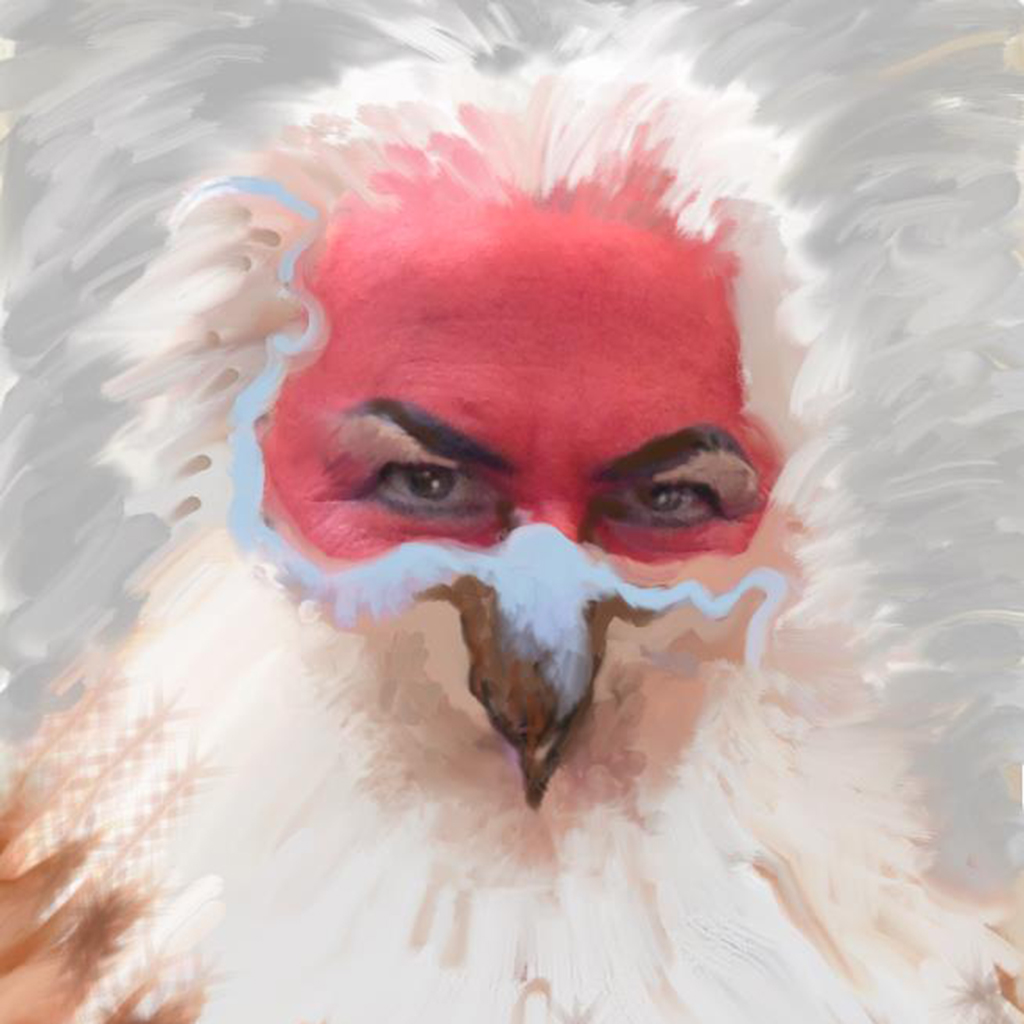
A red dot strictly sits in the corner of Madam Roulin’s eye, next to the pure green and blue in her eye. For his own self-portraits he cut the swaying rich golden corn and wove it to perfection with the green of grass, and pale purples, blues and reds from the vineyards. He mostly never highlighted his eyes with that pure white dash and as a result he pulsed on the canvas, a choice less trembling, his flesh made of gentle irises, neatly cropped grass, dancing vine, pink blossoms, his beard relishing oranges and blues.
He took the brushstrokes of the irises and made a coat for himself. He carried the swirling sky on his forehead with thick circular strokes. His hair like ‘Wild vegetation’ grew with cross hatching and circles and little mad squiggles.
And through all these swathes of harmonious colour, form and structure, his penetrating, firm, loving gaze stood out. He was beyond death, which he intimately knew while he lived and suffered. He was beyond colour, beyond religion.
And he said to us- ‘What is done in love, is done well.’
And we say to him- We love you for the life you lived and we thank you. We hear you dear Vincent; we must, and more so today, in these times when man chooses to annihilate himself, judging by the colour of his skin, labelled by the religion he practices. Lost in space and out of touch with nature.